Disclaimer: The historical accuracy of Tharamant’s LAst Day is heavily disputed.
Being often described as the turning point of a whole civilization, the sudden and terrifyingly precise invasion of Alâon’s most economically advanced city still fascinates historians, artists and the general public up to this day. It is easy to see why: The Fall of Tharamant tells the old story of humankind’s struggle to maintain eternity. It seems to confirm the notion that whenever a new society steps into the light, it is already determined to vanish someday. It seems to say that not even the mightiest and stablest of places last forever. It seems to say that even if a city like Tharamant survives hundreds and thousands of years within an ever-changing environment, the day of destruction will inevitably come.
Taken from the Open Worlds Encyclopedia
The historical event of Tharamant’s Fall has been adapted to nearly every medium of art, including such famed novelizations like its oldest, liberally fictionalized interpretation in Tharamant’s Last Day by none other than Vedian Bordakane himself, who to his own last day insisted that he wrote down nothing but the truth. The short novella, written during Bordakane’s own escape from Tharamant, follows the paths of four characters through the first day of Tharamant’s destruction. Despite poor style, sensationalism, jittery jumps in perspective and poor narration, the novella managed to capture a wide audience after its quick publication in Gadagor. It’s sequels, which covered day two and three of the destruction of Tharamant, were written an published within a couple of months, prompting critics of Bordakane to suggest that he was cashing in on the catastrophe.
Still, other than in its sequel called Echoes from the Sun, which focused on the huge exodus of the Alâonians, there are some nuggets of truth in Bordakane’s trilogy of novellas. Bordakane actually bothered interviewing other survivors, even a couple of Scaruba deserters, to inform his writing. However, it is fair to assume that he combined multiple accounts into single characters. In addition, it is likely that his unfavorable depiction of his lover, Vherendie, who separates herself from him at the beginning of Tharamant’s Last Day, was written out of spite, because he was known to be a petty man. Vherendie Sela, of course, became a historical figure in the following years with a pivotal role in the coming exodus, and the overwhelming evidence exhonorates her from any of Bordakane’s claims.
For a more accurate look on the Fall of Tharamant as well as the following war, historians generally recommend to read Witnesses of Tharamant. It was written by journalist Divhar Mhorben. Although not even being born yet when the city was invaded, his book aims to tell the real stories behind the destruction of Tharamant. The accompanying audio series, featuring full-length interviews with some of the last survivors of the attack, has been digitalized from the soundbooks popular among the exodites, and is available in the Open Worlds Archive.
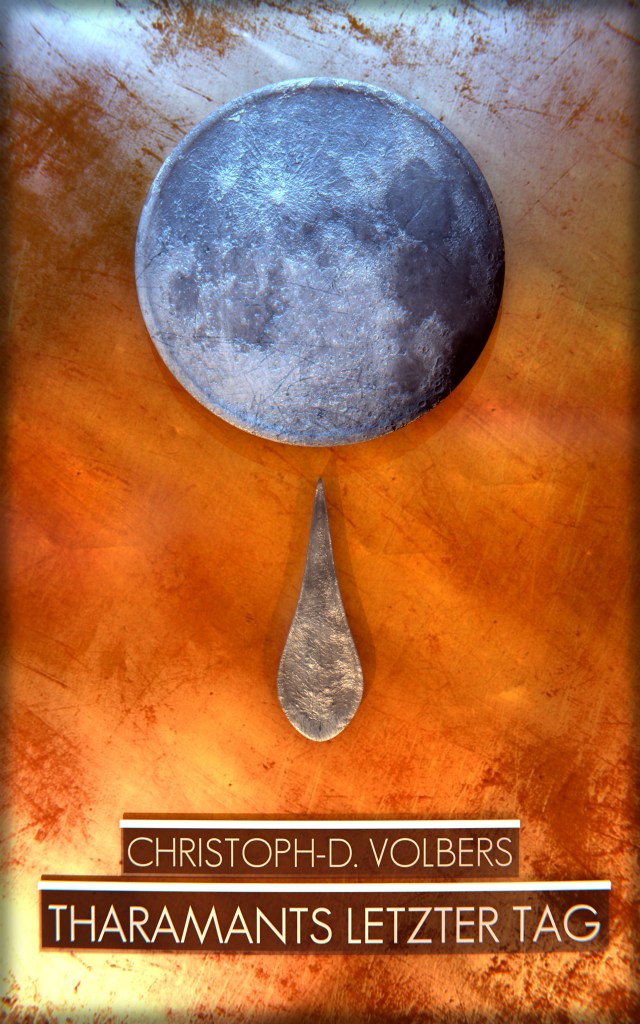
Teil 1 von 3 von Tharamants Fall
Eine Studentin vor einer Entscheidung, ein Historiker im Rampenlicht, ein Koch mit geheimen Kräften und eine Journalistin mit großen Zielen: Vier Menschen erleben den Beginn einer Katastrophe, die ihre Leben für immer verändern soll.
Content Warning für die gesamte Reihe:
Bio-Horror, Schwarmwesen, körperliche Gewalt und Auseinandersetzungen mit (mitunter) tödlichem Ausgang, militärische Invasion, Angriffe auf Zivilbevölkerung, Kriegsmaschinen
 christoph-david volbers